Unlock AI Productivity—Without Losing Control.

Harness the power of our AI-driven technology to elevate your business operations. We offer comprehensive solutions tailored to meet your enterprise security needs while ensuring seamless integration and minimal disruption. Discover how our cutting-edge capabilities can give you a competitive edge.

Deployment

Software-only

Hardware

Zero uCPE

Licensing

Named-user

Watch Our Overview Video

See how this product will change how your organization approaches security
The Buyer Problem

Shadow AI is already inside your network.

Slow secure access pushes users toward unsanctioned tools — and traditional point products can’t see where AI traffic actually flows.

Browser-based AI

Employees are already pasting sensitive data into AI tools that IT never approved.

Embedded AI agents

Developers and power users wire agents into internal apps, APIs, data, and GPUs.

Local assistants

Personal copilots run on managed endpoints, outside normal governance.

Fragmented stacks

Point products create split visibility, split policy, and slow response.

What Cloudbrink Delivers

One platform. Six outcomes.

Built on Cloudbrink’s high-performance ZTNA so legitimate AI workflows actually feel fast.

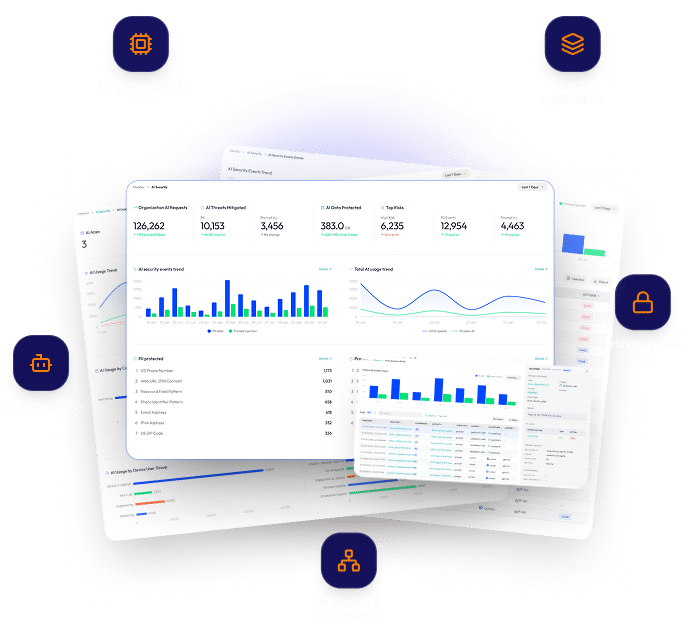
Detect shadow AI and give direct visibility into AI tools, agents, and data movement.

Apply least-privilege and policy controls to AI traffic and AI-enabled workflows.

Detect and manage local personal AI assistants via posture checks and custom scripts.

Protect sensitive data by detecting, blocking, or redacting risky AI exchanges.

Secure, high-performance access to enterprise AI, private resources, and GPU infrastructure.

Keep AI security, internet security, app access, and telemetry in onemanagement plane.

Capabilities That Matter

A decision matrix, not a feature list.

Decision area

Decision area

Decision area

Decision area

AI discovery
Can the platform identify AI tools and AI agents?
Built-in AI agent/service definitions plus portal visibility.
You cannot govern what you cannot identify.
Shadow AI control
Can it spot unsanctioned AI use?
Detects shadow AI and monitors common AI services.
Shadow AI is often where data leakage begins.
Endpoint AI control
Can it handle local assistants or copilots?
Posture checks and custom-script detection for endpoint AI assistants.
Browser-only controls miss local tools.
Data protection
Can it stop or reduce risky data movement?
Detects, blocks, or redacts sensitive data to and from AI services.
AI security without data protection is incomplete.
Unified visibility
Is AI telemetry separated or integrated?
Integrated into the same Cloudbrink portal and policy experience.
Operational simplicity improves response time.
Performance
Will the control plane slow AI down?
High-performance secure access and predictable connectivity.
If sanctioned AI is too slow, users route around policy.
Private AI access
Can it secure internal AI and GPUs?
Safe, fast access to private AI and shared GPU resources.
Most enterprise AI value sits inside private systems.
Architecture in plain english

Identity, posture, edge — then AI.

The Cloudbrink App runs on the endpoint. Identity and posture checks evaluate before access. Traffic steers through secure software-defined FAST Edges and connectors. The same architecture identifies AI services, applies policy, protects sensitive data, and preserves performance for legitimate workflows.
Endpoint

Cloudbrink App

Laptop
Mobile
Browser AI
Local AI
FAST Edge

Policy + posture

Identity
Posture
AI policy
Data DLP
Destinations

AI / Private / SaaS

Public AI
Private AI
GPU pool
Internal apps
Why this is attractive to IT

Less sprawl.
More signal.

No user-side hardware

No uCPE. Software-only rollout fits modern IT.

Named-user licensing

One license instead of gateway, bandwidth, and visibility modules.

One unified portal

Users, apps, internet, and AI activity in a single console.

Identity built-in

Continuous posture checks are part of the base platform.

Faster time to value

Software-only deployment supports rapid rollout.

Best-fit scenarios

Where Cloudbrink
fits.

Apply least-privilege and policy controls to AI traffic and AI-enabled workflows.

Security teams needing AI visibility without another standalone console.

Companies concerned about unmanaged endpoint AI behavior.

Enterprises building private AI, internal agents, or GPU-backed workflows.

IT teams under pressure to preserve UX while increasing governance.

Capabilities That Matter

A decision matrix, not a feature list.

Question 01

Show how the platform identifies AI tools, AI agents, embedded AI, and shadow AI in the portal.

Question 02

Show a policy that treats AI traffic differently from general web traffic.

Question 03

Show how a local AI assistant on an endpoint is detected and what enforcement options follow.

Question 04

Show what sensitive-data controls look like in practice: detect, block, redact, and log.

Question 05

Show how AI usage is correlated with user identity, device posture, and session conditions.

Question 06

Show how private AI resources, internal APIs, and GPU systems are accessed securely.

Question 07

Show reporting and export options for SIEM, audit, and compliance workflows.

Question 08

Show what happens to user experience under degraded network conditions.

Validate carefully

Potential gaps to validate.

Every platform has edges. Pressure-test these areas before signing.

Breadth and update speed of AI-service definitions.

Operational workflow for custom AI-agent definitions.

Exact sensitive-data detection and redaction scope.

Integration depth with existing identity, endpoint, and security analytics tooling.

Granularity of enforcement actions and exception handling.

Reporting completeness for governance and audit use cases.

Short comparison lens

How Cloudbrink stacks up.

Versus a browser-only AI control tool

Cloudbrink is broader — endpoint posture, network performance, secure access, and private-resource connectivity.

Versus a generic ZTNA tool

Cloudbrink emphasizes AI-specific visibility and AI traffic control, not just user-to-app access.

Versus separate AI and SASE point products

Simpler operations through a single platform and policy plane.

Versus blocking AI entirely

Cloudbrink delivers safe adoption — not blanket prohibition.

One-page takeaway

Enable AI safely.
Not blanket prohibition.

Decision statement

Cloudbrink should be evaluated when the goal is to enable AI safely, not just restrict it.

Simple message

AI visibility, AI-aware control, and high-performance secure access in one software platform.

Operational upside

Less console sprawl, easier policy alignment, faster investigation of AI-related risk.

Technical upside

Identity, posture, mTLS-secured connectivity, software-only deployment, FAST Edge performance.

Main proof requirement

Live demo of AI discovery, enforcement, endpoint assistant detection, and reporting including embedded AI.